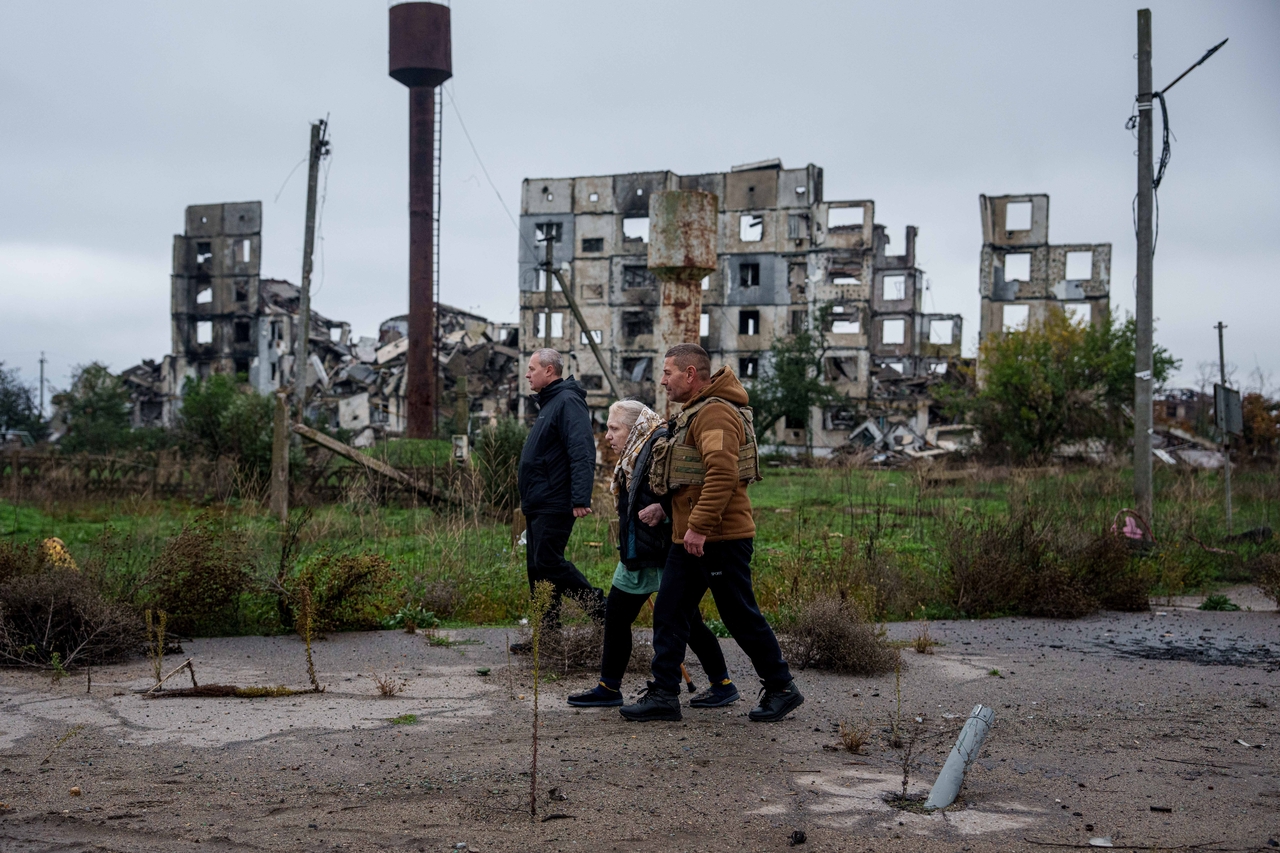
KYIV, Ukraine (AFP) -- Ukraine said Monday that Russian strikes on a school distributing humanitarian aid killed at least 26 people, dashing fragile hopes of "progress toward peace" after a localized ceasefire in the south expired without violations.
Russia resumed strikes on the southern Kherson region after the ceasefire ended, marking the conclusion of the longest truce between the neighbors since Russia's full-scale invasion in 2022, Kyiv said.
The rare pause in fighting, brokered by US first lady Melania Trump to enable a humanitarian mission to the Russian-occupied city of Oleshky, began Tuesday and ended Sunday, with neither side reporting violations.
Hours after the truce ended, Russia targeted a village in the neighboring Zaporizhzhia region with repeated strikes that killed at least 26 people, the acting regional governor said.
Some of those killed had come to collect aid at a local school.
Footage posted by Ukrainian emergency services showed the building reduced to piles of smoldering rubble as rescuers worked at the site.
"Every Monday, humanitarian aid was distributed to people there," Ukrainian President Volodymyr Zelenskyy said in his daily address.
"The Russians carried out the first strike just as people arrived -- several aerial bombs. Then, there was a repeat strike -- more aerial bombs, this time targeting the shelter."
Among those killed were "two rescue workers and four police officers," acting regional Gov. Mykhailo Semikin said on Telegram.
The emergency service identified the rescuers as Denys Konovalenko and Oleksy Sushchevsky, both 44.
"Every day, they went out to help people, working in dangerous conditions and risking their own lives to save others," it said.
Zelenskyy said that after the Oleshky truce, "there was a moment when the next steps could have shown that progress toward peace was possible."
"With these killings, Russia is sending an entirely opposite signal: Russia is counting on more killings. There must be a response to this."
The ceasefire enabled the evacuation of civilians from Russian-occupied Oleshky.
It was the longest pause in fighting between Russia and Ukraine in a war now grinding through its fifth year after killing hundreds of thousands of people and displacing millions.
A senior Ukrainian official told AFP on Sunday that Russia had rejected a Ukrainian proposal to extend the truce.
Ukraine's military also alleged that Moscow used the pause in fighting to "fortify its positions."
Kremlin spokesperson Dmitry Peskov did not deny the accusation, telling reporters Monday, "This is a completely normal practice in such situations."
He alleged that the Ukrainian military had also used previous pauses in fighting to regroup.
Moscow regarded the Oleshky humanitarian mission as "successful," Peskov said, praising the "good cooperation between all sides."
The mission was overseen by Russian human rights commissioner Yana Lantratova and her Ukrainian counterpart, Dmytro Lubinets, in one of the most substantial instances of Russian-Ukrainian cooperation since the war began.
Residents were evacuated to both Ukrainian-controlled territory and Russian-annexed Crimea.
The Kremlin said no other similar missions were planned "at the moment."
US-led talks between Russia and Ukraine are set to resume next week, US special envoy Steve Witkoff said Monday.
President Donald Trump has pushed for a settlement to the war, but there has been no breakthrough.
The talks are scheduled for Nov. 10-11 in Abu Dhabi and are expected to focus on postwar security arrangements, de-escalation, humanitarian measures and efforts to end the war.
Both Russia and Ukraine also said their emergency warning apps were hacked overnight in apparent cyberattacks that came hours after the truce ended.
Ukraine said it suspected its air raid alert system had been compromised after false alerts of a radiation threat were sent to millions of users.
The warning system provides vital information about incoming Russian drones and missiles.
Russia has intensified its attacks this year, firing ballistic missiles and fast jet-powered drones, both of which are difficult to intercept.
Moscow said an app belonging to its Emergency Situations Ministry that also warns of attacks had been hacked.
The app is not widely used in Russia, where warnings of Ukrainian drone attacks are less common and are typically sent by text message in border regions.